Celebrating 100 Years of Light
Call Us: 631-421-1985

History

Xanax should be used only if the anxiety is severe or disabling, and if the patient is suffering due to the disturbance in extreme discomfort.

Historical Guide for the Huntington Harbor Lighthouse


 Lloyd Neck Lighthouse

Northeast storms, churning from the sound from Mystic to Oyster Bay can be wicked, as any mariner knows. At the widest reach, southwest from New Haven, and a 45–knot Northeasterly wind can create a real sea. At night before 1857, ships had no choice but to run in the dark for shelter in land-locked Lloyd Harbor. Sometimes they came to grief along the spur that juts out southward from the tip of Lloyd’s Neck. For this reason in 1847, the government bought five acres of sand on a peninsula from Jonah Denton (1812~1892), whose family had owned the property on the Neck for several generations, after having purchased it originally from Daniel Whitehead of Oyster Bay. In 1857, the original area lighthouse was built on the tip of Lloyd’s Neck at the end of East Beach to be visible to any craft that cleared Eaton’s Neck. It marked the entrance to Lloyd Harbor and in moderate weather, served vessels making their way at night through “the Gut” into Huntington Harbor. The Lloyd Neck Lighthouse consisted of a 2 story white wood framed house with 11 rooms attached to a brick lighthouse tower with a 5th order Fresnel lens and an “ Argand” lamp. The Argand lamp used a round (tubular) wick where standard kerosene lamps have a flat wick. The Argand lamp was both brighter and cleaner burning than a standard kerosene lamp. The wick had to be trimmed daily to keep the lamp burning at maximum brightness. The lamp burned “oil” or kerosene at the rate of 3 to 4 ounces per  hour. This first lighthouse was of little help to ships entering the adjoining Huntington Harbor. In 1912, a new lighthouse was built to serve Huntington Harbor. Although the Lloyd Neck Light was not used as a lighthouse after 1912, it served as the keeper’s residence until 1925. On November 12,1947, the wooden structure of the original light was destroyed by fire. A news article in the Nov 13th Long Islander paper states “ It was believed that hunters had occupied the building Tuesday night and through carelessness in having a fire inside one of the old fireplaces caused the blaze that destroyed the lighthouse”.


The ruins of Lloyd Neck light can still be seen today looking directly west at East Beach of Lloyd Neck from the lighthouse.


Keepers of Lloyd Neck Lighthouse

John S. Wood:   June 1857- August 1857

Abiathia Johnson: August 1857  – May 1861

A. Poantcall: May 1861 – September 1861

A. Johnson:  September1861 – April 1869

S.C Darling: May 4, 1869 – April 13,1874

George R. Johnson:  April 1874 – November 1884

Neil Ward: November 1884 – September 1885

Robert Mc Glone:   September 1885 – Feb 1911


The last two official keepers of the light were Robert McGlone and Caretaker Augusta “Gussie” Harrigan. The five acres of lighthouse property became known as the “eminent domain” of McGlone, his wife and five children. With infinite labor, McGlone brought


topsoil from Lloyd’s Neck to make a garden plot that had been cleared of native growth. Then, in 1900, tragedy darkened the happy home when Mrs. McGlone and her sixth

child died in childbirth. The later celebrated Augusta “Gussie” Harrigan, a local, 31 year old spinster, came to the lighthouse to take care of the five motherless McGlone

children. When the government erected a new lighthouse at the entrance to Huntington harbor in 1912, Robert McGlone was made its first keeper. “Gussie” and the children

remained at the old lighthouse. Ms. Harrigan eventually became the caretaker /resident keeper of the light at the old lighthouse until she officially retired on October 1,1925 at the age of 56 years. Shortly after her departure, vandals went to work destroying this guardian of the night.

Huntington Harbor Lighthouse

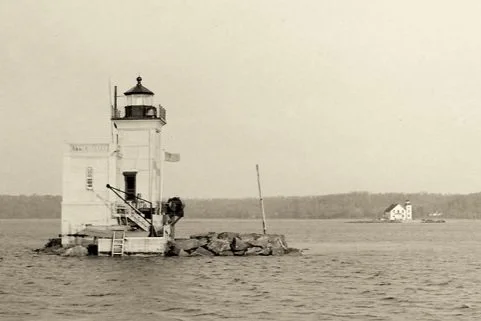
On March 7,1907, Congress appropriated $40,000 for construction of a new lighthouse on a reef extending north from West Neck at the entrance to both Lloyd Harbor and Huntington Harbor. The new structure completed in 1912 was a unique lighthouse, in both design and construction. The Venetian Renaissance (Beaux Art) style makes the light look like a small castle. The reinforced concrete foundation and structure is unique to the area as well. The crib or foundation for the light was built nearby on land at “Sand City” then floated to the present site and sunk.  It was sunk by filling it with water, to the hard-sand bottom of the reef that had been leveled and cleared of rocks. The interior spaces were filled with concrete, which resulted in an extremely heavy, stable footing for the new light. The site also included a band of riprap (a wall of large stones thrown together without order), which surrounded the foundation to protect the lighthouse.

An octagonal lantern gallery surrounds the two-story tower. The original lantern was a fifth order Fresnel lens. Screwed to the floor of the gallery is a large fog signal bell embossed with the date and city of origin: Jersey City, N.J. 1911. The bell weighs 1000 pounds and was added to the light in 1912. It had to be rewound every three and one half hours.

Rising through the center of the tower is an iron column to which is attached a circular cast iron stairway leading to the gallery above. At one time the keeper’s dwelling had a kitchen, sitting room and one bedroom. The cellar had an oil room, coal room and a 2000-gallon water cistern. Keepers drew the water from the cistern by using a hand pump in the kitchen. Huntington Harbor Lighthouse is essentially the same structure today, inside and out, that was built in 1911. When the new lighthouse was built it did not have any modern conveniences; no electricity, running water and no indoor plumbing. This lighthouse housed members of the Lighthouse Service, and then the US Coast Guard, for 55 years. In 1939, the US Lighthouse Service was dissolved and the operation taken over by the US Coast Guard. After the Coast Guard automated the light in 1949, the handsome and unique lighthouse gradually slipped into decline. By 1985, the deterioration of the lighthouse had become so great that the Coast Guard was ready to destroy it and erect a steel tower on the ruins. They would have done that, too, if it had not been for the cries of protest from the boaters, shipping interest and local inhabitants.  The Coast Guard relented when a group of concern citizens led by Janis Harrington, a teacher from Greenlawn,  organized the Save Huntington’s Lighthouse Inc. whose stated goal was to save and restore the lighthouse. In 1988, the Huntington Lighthouse was added to the National Register for Historic Building, Reference No. 890000501. The Huntington Lighthouse is currently leased to the Huntington  Preservation Society (formerly Save Huntington Lighthouse Inc.) and is an active aid to navigation with the light as the main signaling device along with the foghorn, which is maintained by the US Coast Guard.

The tower height is 48 feet tall with the focal plane of the light at 42 feet above mean high water. In 1949, the Coast Guard automated the light and installed the foghorn to replace the bell.


Keepers of Huntington Harbor Lighthouse

Robert McGlone (February 1,1911~January 31,1919).

Robert McGlone, who had been keeper of the original light since 1885, was appointed first keeper of the new light in 1911. When he died in 1919, he had served 34 years at both lights.

John Grimes (February 1,1919~ March 31, 1919).

Acting lighthouse keeper, succeeded McGlone on February 1, 1919 but only lasted two months.

Marvin E Burnham – (March 31,1919~September

3,1926).

James Galler – (October 1,1926 ~ March 31,1928).

Andrew Zuius – (April 1,1928 ~ March 14,1929).

E.S. Bunner – (March 14,1929 ~ July 1,1930).

Appointed lighthouse keeper and was dismissed five months later for an unknown reason, possibly for drinking.

Joseph Dubois – (July 1, 1930 ~ June 30, 1933).

Robert L. Howard – (July 1,1933 ~ December 31,1935).

Authur Bouder – (January 1, 1936 ~ March

31,1938).

Louis Anderson – (P/T Keeper 1935 & 1936)

(Lloyd Neck & Cold Spring Harbor)


Louis

Anderson

At the age of 96, Louie was an active member of the Huntington Harbor Lighthouse Preservation Society.

Richard J. White – (April 1, 1938 ~ June30, 1942)

He was transferred from West Bank Light in Lower New York Harbor. When the Coast Guard assumed jurisdiction over all aids to navigation in 1939, it allowed White to stay on as a civilian keeper until he retired in 1942.


 Main Floor Keeper’s Rooms (Bedroom & Living Quarters)

There were numerous keepers who were stationed here at this lighthouse over the years. As you enter the lighthouse, you will enter the “parlor” or main room, which was used as the keeper’s primary living space. It served as the kitchen and living area for the keeper. Through the door on the left was the bedroom. This 9 ft by 12 ft room with a small closet was the only sleeping area for the lighthouse keeper. The walls of the lighthouse are approximately 24” inches thick at the base and 8 inches thick in the living quarter. The wall construction consists of a 4″ thick outer layer of concrete, a layer of terra cotta tiles with a final coat of cement to provide the finished wall along with the beaded wainscoting. There is NO insulation in these  walls .A small potbelly coal stove to the left of the door was the only source of heat. It was also used for cooking and keeping the coffee warm. The Light keeper hardly slept, as he had to be up several times during the night to check the light and refuel the lantern. The oil or kerosene for the lantern and the coal for the stove was stored in the basement. A dumbwaiter or ”silent butler” was used to bring the coal and kerosene up from the basement. The two lower cabinets, sink and stove are original to the lighthouse.

Before & After


Interior Restoration – Living Quarters 2010


The Kitchen Area


The kitchen was the heart of the lighthouse; something was going on there a good part of the day with the preparation of meals, baking, and of course coffee brewing. As was everything in the lighthouse, cooking methods were rather primitive. The coal stove meant that it was nice and warm in the winter but a bit toasty during the

summer months. Water was collected from the roof into a cistern located under the kitchen. It was then pumped by hand when needed, using the old-fashioned hand pump on the sink.

 Bathroom

Originally, there was no bathroom in the lighthouse. Bathroom facilities consisted of an “outhouse” mounted on a set of stilts that were attached to the east-facing walk of the lighthouse, opposite the front door. A fun experience in the winter for sure. As the story goes, this allowed the keeper to do his business and allowed him to fish at the same time. There was no indoor plumbing until 1928 when a bathroom was installed in the basement of the lighthouse. Laundry was done by hand in the old days. Ironing was done with a cast iron flat iron that was heated on the kitchen stove.


The Stairway

The spiral stairway, which is narrow and winding, is integrated into the lighthouse tower. The stairs provide access from the basement to the watch deck. The spiral staircase is built around a large hollow column. Within the column is a set of weights that powered the Stevens Fog Bell striking apparatus & mechanism that rang the bell. The weights moved up and down the column just like a grandfather clock. Today the weights are rusted together inside the hollow column. One of our future projects is to free up these weights.


The Watch Deck

The watch deck is located on the second floor beneath the lantern room. It has a ladder, which provides access to the lantern room thru a small hatch. This is the heart of the lighthouse. It is here that the keeper did his work. A door leads out onto the roof of the watch deck. This deck was the water catcher to fill the cistern in the basement. Looking out through the windows he could watch for incoming ships. Under the stairs is a small cabinet built into the wall. Here he would store extra lamps, wicks and several cans of kerosene. A lamp maintenance box was also kept in the cabinet. It contained the tools and polish he needed to maintain the lamp.


The Fog Bell

The first fog bells were rung by hand, but around 1912, the Lighthouse Board installed mechanisms to ring them mechanically. Falling weights were used at first, but the “clock work” system as we have here (where the falling weight is the source of power) was soon adopted, as it was both more practical and reliable. The Huntington Harbor fog bell was manufactured in Jersey City, N.J. in 1911. It rang once every fifteen seconds. The fog bell chores of the light keepers improved with the installation of semiautomatic ringing mechanisms. It is fixed in a steel frame. The striker or hammer was mounted on the outside and is controlled by the Stevens machine in the watch room below. The

system used in the lighthouse is a weight and pulley escapement system that used weights that could be “wound” to start a timed session. Not unlike a grandfather clock, the system needed to be periodically rewound every 3½ ~ 4 hours to insure that the fog bell continued to sound throughout the duration of fog conditions. In the basement, the original weight has been rusted in place. An effort is under way to loosen the rust and restore that part of the system.

Should the escapement mechanism fail, the keepers then had to sound the bell manually, at timed intervals and for the duration of the storm or fog. Consider the conditions of this effort between the hard and seemingly endless labor and the close-by clang of the bell. This dedication to duty and to the safety of others is a landmark of the US Lighthouse Service and its successor, the US Coast Guard.

Today, an electric foghorn is used at Huntington Lighthouse to replace the original bell. The last thirty or forty years has seen the development of the soundless fog signal: the radio beacon and GPS (Global Positioning System), which uses satellites orbiting the earth to pinpoint your position.

As you go up the ladder into the lantern room, look to your left. On one of the metal beams you will see the marking “Carnegie 09” The writing is upside down but it is clear as to who supplied the structural steel for this lighthouse. This is the marking of the Carnegie Steel Company, with the “09” signifying it was manufactured in 1909. In another location another steel beam is marked Roebling Iron Works, which is the same steel plant in Brooklyn, New York that produced the materials for the Brooklyn Bridge. A wooden door provides access to the deck of the lighthouse, which was used to collect rainwater for the cistern. A beautiful view of the surrounding area can be seen from the watch deck and lantern room.

The Basement

Descending the spiral staircase leads to three chambers in the crib or basement of the lighthouse.  Down here the walls of the lighthouse are approximately 24” inches thick. On the left is the “Oil Room”.  This is where the lamp oil (kerosene) was stored to fuel the light.  The dumbwaiter “Silent Butler” was installed in the corner and was used to take both the oil and coal up to the living quarters to assist the keeper in his chores.

 In the middle chamber was the Cistern. It was used to store the fresh water for the lighthouse. The rainwater was collected from the roof and piped down into the cistern. A hand pump took the water from the cistern into the kitchen sink. The cistern is constructed of a double layer of bricks to hold the water for the lighthouse.

On the right was the Coal Room. Here the coal was stored to heat the lighthouse in the single potbelly stove in the main room. An interior bathroom was added in 1928 to replace the outhouse (privy) located on the lighthouse platform.


The Lantern Gallery

This is a platform in the lantern room where the fifth order Fresnel lens of the lighthouse was located. Before modern technology and automation, the keeper would have to keep the light shining. Every night he would have to light the lamps and make sure that they burned brightly and did not run out of oil. This usually meant several trips a night up and down the stairs. During the hours of darkness, the “light” was never to go out and if the Lighthouse Service received complaints that the

light was not lit or that it was poorly lit, the light keeper would be in danger of losing his job. In the morning he would have to clean the soot from the lantern room,  clean the lens, polish the brass and make the lamps ready for the following night.

This was a common task that had to be done every day. The lantern room as well as the entire lighthouse was subject to periodical inspection by a Lighthouse Service District Inspector. If all were not in ship-shape condition the keeper would be written up and warned. If the lighthouse continually did not meet the Lighthouse Service standards, the keeper would be replaced. However if all was well, he would receive praise and usually a written commendation. The Lighthouse Service had very strict regulations as to how a lighthouse should be kept. The original light of both lighthouses was a fixed 5th order fresnel (Pronounced freh-nell) lens light. The focal plane of the light is 42 feet above high water mark. The lens did not rotate but cast a steady light. In the center was the kerosene-powered lamp. The lamp would burn 3 to 4 ounces of fuel for each hour of operation. When kerosene burns, it produces a light, heat, oil vapor and carbon or lamp-black. This layer of dirt had to be removed from the lens daily, as it coated the lens and cut down on the light emitted from the lens. The original 5th Order Fresnel glass lens was approximately 22 inches tall and 15 inches in diameter and weighed 400 pounds. One of the keepers many jobs were to polish the glass and its brass frame daily. Materials he needed were kept in the cabinet in the watch room. When the light was in proper working order it could be seen from 7 to 9 miles away. Red panels were added to the southern-most windows to warn the mariners of the rocky shoal on the West Bank of Huntington Harbor. The color sector was used to mark special areas such as the shoal and channel. Fresnel’s priceless, hand-cut lenses have disappeared from most of the lighthouse in the United States as the Coast Guard replaces them with more modern, economical plastic lenses. The light was then changed to a 300-MM optic, with a flashing white light every 6 seconds, which was automated in 1949 and is turned on at night by means of light sensor.

This electric lamp could be seen for a distance of approximately 8 to 9 miles.

There is a small (Ferris wheel) type mechanism inside the lens. It contains six 2-½ Watt bulbs. Only one bulb is lit at any time. If the bulb burns out, this mechanism automatically moves the next bulb into position so the light is always functioning. Today, only four lighthouse in the Long Island Sound still have Fresnel lenses, as a working lantern: Eaton Neck Light (working 3rd order, Block Island SE Light (working, 1st order); Point Judith Light (working, 4th order); and Lynde Point Light (working, 5th order). Other Fresnel Lenses can be seen on display at the following locations: Little Gull Island Light (on exhibit, 3rd order); Horton Point Light (on exhibit 4th order), Plum Island Light (on exhibit East End Seaport Museum 4th order), Fire Island Light (on exhibit 4th order), and Little Gull Island Light (on exhibit, 3rd order); and Montauk Point light with four lenses on exhibit: 3.5 order bivalve, two 4th order and a 5th order). Looking out from the light chamber you can see three solar panels mounted on the railing. These panels charge the three batteries that keep this modern light functioning as a temporary measure. In 2006, the USCG has updated this system with much larger panels to supply power to the lamp and foghorn. Electric power is no longer supplied to the lighthouse from a shore source. This was due do the expansion of ice which cut the cable in the winter of 2002. The USCG does not want the responsibility of maintaining the power cables. So in the future, all offshore lighthouses will be solarized.

A fog detector (white box) is installed outside the lantern room, which operates the foghorn when the visibility is drops below one mile.

In 2011 the USCG changed the light in the Huntington Harbor Lighthouse to a high-powered LED light.  It can be seen for many more miles!


USCG Solarization  of Huntington Light


Solarization  Panels


All Equipment is located on the Watch deck


Huntington Bay – Local History

From the lantern room if you look to the north you will see the Long Island Sound with Connecticut in the background approximately 12 miles away.  Toward the right, you can just make out the Eaton Neck Lighthouse, which is operated by the USCG. Towards the left is Lloyd Harbor. This area was rich in clay beds and about 1760 a large foundry called Crossman Brick Co. was established to make brick, which were shipped out on barges to a growing Manhattan. This area, which was the Matinecock Indians name for Lloyd Neck, Caumsett, and meaning, “place by sharp rock”, is the name for the 1426-acre State park, in which Target Rock National Wildlife Refuge is located. This large rock which is sitting in the water in line with bell buoy “8” is named “Target Rock”. British warships would use Target Rock for shooting practice. If you walk south along East Beach, you will come upon the ruins of the original Lloyd Harbor Lighthouse and the entrance to Lloyd Harbor. To the south is the entrance to Huntington Harbor with Sandy Beach to the right. This is a private beach owned by the residents of Wincoma. Many boat captains had wished that the lighthouse had been built much sooner as many ships found themselves grounded on the rock while entering Huntington Harbor. Looking down the entrance to Huntington Harbor, you can see Coindre Hall and the great lawn. This majestic castle was built by pharmaceutical tycoon George Brown for his wife. It is now called the Gold Coast Museum and serves a multitude of uses for community functions. This is a Suffolk County Park and the Lighthouse can be viewed from this location. Also located in Huntington Harbor, the Huntington Yacht Club founded on September 15, 1894,  had an initial entrance fee of $25 with annual dues of $15 for membership. To the east is the entrance to Centerport and Northport Bay and a strip of beach is known as West Beach Park. “Sand City” is located adjacent to this beach and this is where the lighthouse crib was fabricated.


The Town of Huntington History

When white men arrived here the main tribe of Indians in the area was the Matinecocks led by Chief Raseokan, also spelled Ashoroken. The main camp sat on what is now the Keyspan power plant. The Marapaques led by Tackapousha resided to the southwest and the Sucatoues led by Resorsechck resided to the southeast. The tribes paid an annual tribute to the New England tribes, but they recognized the sovereignty of the great Sachem Chief Wyndanch. The territory, ruled by the Matinecocks was called Ketewomoke.  The Indians called the neck of land Caumsett meaning “place by sharp rock”. The Town of Huntington dates from April 2nd, 1653, when three Oyster Bay men bought from the Matinecock tribe, a parcel of land that is now known as “the “ First Purchase.” The Oyster Bay men immediately turned the land over to a group of white men who had already settled within its boundaries.

Most of the early settlers were English people who came to Huntington by way of Massachusetts and Connecticut. As a result, they felt more of a kinship with New England than with their Dutch neighbors to the west in New Amsterdam.

In the years between the first settlement of the town and the start of the American Revolution, Huntington became an established community. The earliest settlers

clustered near what became known as the “town spot”, the site of the present Village Green. As the town prospered and grew, people moved to fill the outlying areas. In addition to the many farms that were established in remote as well as central portions of the town, the town included a school, a church, flourmills, saw mills, brickyards, tanneries, a Town dock and a fort.

Huntington’s fine harbor meant that shipping became an important part of the economy. The harbor was a busy place, with vessels traveling not only to and from other ports along the Sound but also as far as the West Indies. Ship making and related nautical businesses prospered, since water was for many years by far the most efficient way to transport both goods and people.

Nathan Hale landed at Huntington in 1776, coming by boat from Norwalk, Connecticut on a spying mission for George Washington. Sent to gather information about the British forces on Long Island and in New York City, he was captured and executed in New York City in September 1776. A memorial stands at the approximate site of his coming ashore in Huntington, an area now known as Halesite.


The railroad was extended from Syosset to Northport in 1867. The arrival of the railroad in Huntington presaged the decline of the maritime economy, although shipping was important until approximately the turn of the twentieth century. Since shipping had long been an important part of the life and economy of Huntington, the Town continued to be connected to the rest of the world. With the increased accessibility of Long Island by steamboats, trains and later automobiles, Huntington became physically less isolated.


Lighthouse Terms

ARGAND LAMP A hollow wick oil lamp (see wick).

ASSISTANT KEEPER Assists the head keeper in the operation of the lighthouse.

ASTRAGAL Metal bar (running vertically or diagonally) dividing the lantern room

glass into sections.

BALL VENT A vent on top of the dome to control airflow.

BRASS VENT A vent in the lens room for controlling air flow to the wick of the

lamp.

BULL’S-EYE A convex lens used to concentrate (refract) light.

CATWALK On a lighthouse tower, a walkway located outside the  lantern room.

BALCONY watch room and/or the lantern room.

CHARACTERISTIC Individual flashing pattern of each light.

DAYMARK Unique color scheme or design which identifies a specific lighthouse

during daylight hours.

DISPERSE Spread out.

DOME or CUPOLA Rounded roof on top of some lighthouse towers.

FIXED LIGHT A steady non-flashing beam.

FOCAL PLANE A plane where rays of light appear to spread after refraction and

reflection in a lens.

FOG SIGNAL A device (such as a whistle, bell, cannon, horn, siren, etc.) which

provides a specific loud noise as an aid to navigation in dense fog.

FOG SIGNALBUILDING Building that houses the fog equipment.

FRESNEL LENS A type of optic consisting of a convex lens and many prisms of glass, which focus and intensify the light through reflection and refraction.

FUEL  A material that is burned to produce light (fuels used for lighthouses

included wood, lard, whale oil, tallow, and kerosene).

HEAD KEEPER Person who takes care of the light in the lighthouse and is responsible for the operation of a light station.

 KEEPER’S QUARTERS Place where the keepers live.

LAMP The lighting apparatus inside a lens.

LANTERN ROOM Glassed-in housing at the top of a lighthouse tower, containing the lamp and lens.

LENS A curved piece of glass for bringing together or spreading rays of

light passing through it.

LIGHTNING ROD A grounded, metal rod placed on a high structure to prevent damage by conducting lightning to the ground.

LIGHTHOUSE  A lighted beacon of major importance in navigation.

LIGHT STATION A complex containing the lighthouse tower and all of the

outbuildings, i.e. the keeper’s living quarters, fuel house, boathouse,

fog-signal building, etc.

LOG A book for maintaining records, similar to a diary.

NAVIGATION The charting of a course for a ship or aircraft.

ORDER Size of the Fresnel lens, which determines the brightness and distance

the light will travel. The size or order of the lens ranges from 1 to 6, with 1 being the largest and 6 being the smallest.

PHAROLOGIST One who studies lighthouses.

REFLECT Bend or throw backlight.

REFRACT To deflect (or bend) light from a straight path.

REVOLVING LIGHT/ROTATING LENS One, which produces a flash or characteristic.

SPIDER LAMP Shallow brass pan containing oil and several wicks.

TOWER Structure supporting the lantern room of the lighthouse.

WATCH ROOM A room immediately below the lantern room

SERVICE ROOM where fuel and other supplies were kept. This is where the keeper prepared the lanterns for the night and often stood watch. The clockworks

(for rotating lenses) were also located there.

WICK SOLID A solid cord, used in spider lamps, that draws fuel up to the flame.

“WICKIE” A nickname given to lighthouse keepers derived from the task of

trimming the wick of the lamps.


LLOYD HARBOR LIGHTHOUSE HISTORY


1838: George Bach recommends the establishment of a small beacon light to aid ships at the entrance to Lloyd Harbor.

1847: US Government purchases 5 acres of sand on a peninsula from Jonah Denton (1812—1892), whose family had owned the property on the Lloyd Neck for several generations, after having purchased it originally from Daniel Whitehead of Oyster Bay.

1854: US Congress appropriated $40,000 for the construction of a lighthouse on Lloyd’s Neck.

1857: Original light constructed on southern tip of Lloyd’s Neck. This light’s purpose was to help ships find refuge in Lloyd Harbor, which is adjacent to Huntington Harbor. The lighthouse was a 2-story white wooden frame structure with 11 room, an attic and an offset white brick tower with a fifth order Fresnel lens. The signature of the lens was a fixed white light.  The house rested on a deeply laid foundation of brick.  This was a large Keeper residence with enough space to house a family.

1857, November 15: Lloyd Harbor light illuminated.

1905: Huntington residents submit a petition requesting a 2nd lighthouse at the entrance to Huntington Harbor.

1910-1912:  The United States Lighthouse Service contracted with the Charles Meade Company to build the new lighthouse at the entrance to Huntington Harbor on the outcrop of rocks approx. ½ mile offshore. The new design featured a floating crib, which was fabricated at a site known as  “Sand City” and towed to the site. The base was sunk with concrete and a terra-cotta block with concrete construction was used and was the first lighthouse to be built in this manner on the East Coast.

1912: Lloyd Neck light transferred to Huntington Lighthouse

1925: Lloyd Harbor lighthouse discontinued as keeper’s residence and the building became increasingly damaged by vandals.

1928: Town of Huntington gains control of original light.1947, November 12: Wooden structure of original light destroyed by fire. Article in the Nov 13th Long Islander states “It is believed that hunters had occupied the building Tuesday night and through carelessness in having a fire inside one of the old fireplaces caused the blaze.”  


HUNTINGTON HARBOR LIGHTHOUSE HISTORY

1905: Huntington residents submit a petition requesting a 2nd lighthouse at the entrance to Huntington Harbor.

1910-1912:  The United States Lighthouse Service contracted with the Charles Meade Company to build the new lighthouse at the entrance to Huntington Harbor on the outcrop of rocks approx. ½ mile offshore. The new design featured a floating crib, which was fabricated at a site known as  “Sand City” and towed to the site. The base was sunk with concrete and a terra-cotta block with concrete construction was used and was the first lighthouse to be built in this manner on the East Coast.

1912: Lloyd Harbor original light discontinued with fifth order Fresnel lens transferred to Huntington lighthouse. The height of the focal plane is 42 feet above high water mark. Its rectangle shape gives it the appearance of a castle.

1924: State of New York obtains original light and property.

1949: Lloyd Harbor lighthouse automated

1967: Fifth order lens replaced by present 300mm optic

1967:  In the September 7,1967 issue of the “Notice to Mariners”, the Coast Guard announced that it planned to close Lloyd Harbor Lighthouse, and replace it with a new buoyage system to mark the entrance to Huntington Harbor. The announcement triggered so many protests from boaters and various shipping and oil companies asking that the light be kept in operation as an active aid to navigation that the coast guard cancelled its plans to discontinue it.

1984: Federal government decides to demolish the 1912 light, originating the formation of Save Huntington’s Lighthouse, Inc.

 1985 : A nonprofit organization called the Save Huntington’s Lighthouses acquired the light station as part of a 30-year land lease from the Coast Guard and the Department of Transportation.

1986: Coast Guard removed collapsed roof.  New roof installed.

1989: Light listed on the National Register of Historic Places. Reference No. 89000050.

1989: The Lloyd Harbor Lighthouse was renamed Huntington Harbor thouse.

1997: New steel dock installed by United States Coast Guard.

1998, July 2. The Save Huntington Lighthouse Board of Directors holds it first meeting at the Huntington Harbor Lighthouse.

2003: Installation of boat float with a ramp to provide access to the lighthouse.

2003: The Huntington lighthouse is opened to visitors for the Town of  Huntington 350th Anniversary.


Our Facebook

Contact Us

Post Office Box 2454, Halesite, NY 11743
Phone: (631) 421-1985
Website: http://www.huntingtonlighthouse.org
Email: info@huntingtonlighthouse.org

Help us Reach our Fundraising Goal!

original fundraising ideas

Events Calendar

May  2013
Mon Tue Wed Thu Fri Sat Sun
   
  1 2 3 4 5
6 7 8 9 10 11 12
13 14 15 16 17 18 19
20 21 22 23 24 25 26
27 28 29 30 31